

Farewell to Potassium Sorbate! Solving the "Bloating & Emulsion Breakdown" Curse in Clean Label Mayonnaise
As consumer demand for "Clean Label" products continues to surge, an increasing number of condiment manufacturers are attempting to eliminate potassium sorbate and sodium benzoate from their formulations. However, stripped of the protection of traditional chemical preservatives, mayonnaise and salad dressings easily become breeding grounds for microorganisms. The acid and gas production by lactic acid bacteria, along with the aggressive fermentation by acid-tolerant yeasts, leads not only to flavor deterioration but also to catastrophic "packaging bloating" and "emulsion breakdown."
Today, we will delve into a natural antimicrobial weapon—Cultured Dextrose—and explore how it fundamentally solves the preservation challenges within the mayonnaise system.
I. The Uniqueness of the Mayonnaise System: Why is it so vulnerable?
From a physicochemical perspective, mayonnaise is a typical Oil-in-Water (O/W) emulsion system. Although its oil content usually ranges from 60% to 80%, the actual "battleground" where microorganisms thrive is its water phase.
- The interplay of low pH and high Water Activity (Aw): The pH of mayonnaise typically ranges between 3.8 and 4.2. This acidity is sufficient to inhibit most pathogenic bacteria (such as Salmonella and Listeria), but it serves as an ideal paradise for Lactic Acid Bacteria (LAB) and acid-tolerant yeasts/molds (e.g., Zygosaccharomyces bailii).
- The culprits behind "Bloating" and "Emulsion Breakdown": When yeasts and heterofermentative LAB multiply in the water phase, they metabolize sugars and generate large amounts of carbon dioxide gas (CO_2). These gases cannot escape the viscous matrix, forming bubbles that cause packaging to swell. Moreover, the physical expansion of these bubbles directly disrupts the fragile oil-water interfacial tension, leading to the collapse of the emulsion structure and ultimately resulting in severe "demulsification and oil separation."
II. The Specific Antimicrobial Mechanism of Cultured Dextrose
Under the constraint of removing potassium sorbate, Cultured Dextrose has emerged as a breakthrough solution for R&D professionals. It is not a single chemical substance; rather, it is a complex of natural metabolites produced by fermenting dextrose with specific food-grade microorganisms (such as Propionibacterium and Lactococcus lactis), followed by pasteurization and spray drying.
Its antimicrobial mechanism is akin to a "precision strike":
- The "Penetration Effect" synergistic with low pH: Cultured dextrose is rich in natural short-chain organic acids (like propionic and acetic acids) and antimicrobial peptides. In the acidic environment of mayonnaise (pH ~4.0), these organic acids exist primarily in an undissociated state. Undissociated molecules are highly lipophilic, allowing them to easily penetrate the cell membranes of yeasts and molds.
- Disruption of intracellular homeostasis: Once inside the microbial cell (where the internal pH is near neutral), these acids rapidly dissociate, releasing hydrogen ions (H^+) and causing a sudden drop in intracellular pH. To expel the (H^+), the microorganism depletes its ATP energy reserves, eventually leading to metabolic arrest and cell death.
- Targeted inhibition of LAB: The natural bacteriocins present in cultured dextrose can specifically form pores in the cell membranes of lactic acid bacteria, causing leakage of intracellular contents and effectively curbing their excessive proliferation in mayonnaise.
III. Empirical Data Support: Challenge Test
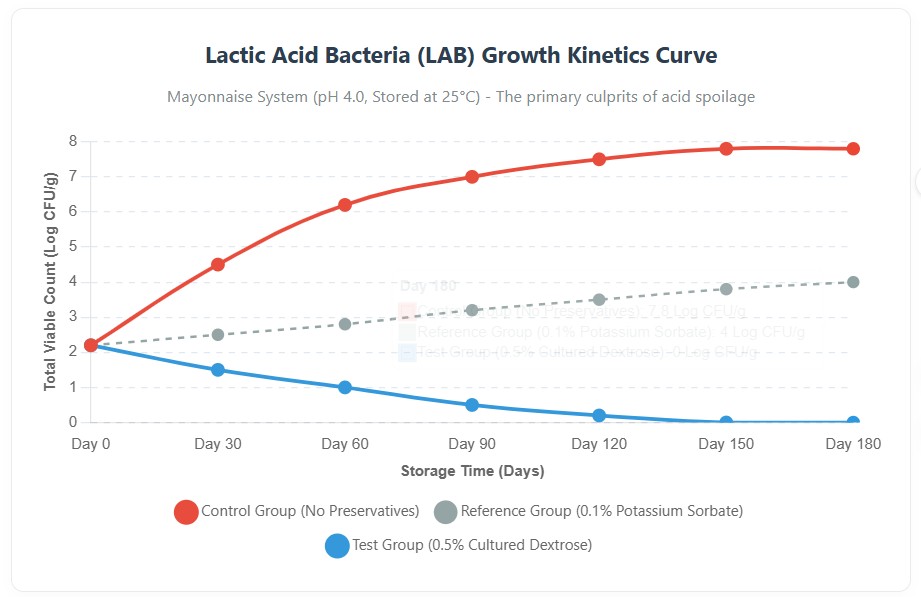
To verify the performance of cultured dextrose in a real-world system, we designed a 180-day microbial challenge test for mayonnaise (stored at 25°C room temperature).
- Control Group: No preservatives added.
- Reference Group: 0.1% Potassium Sorbate added.
- Test Group: 0.5% Cultured Dextrose added.
The samples were inoculated with a cocktail of LAB and acid-tolerant yeasts, with an initial inoculation level of approximately (10^2) CFU/g. The dynamic monitoring data is as follows:
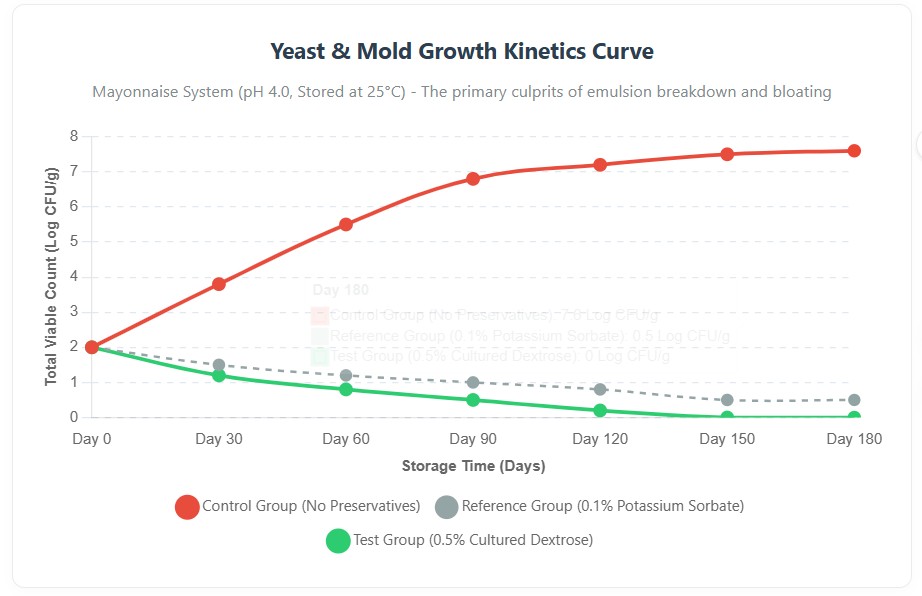
- Yeast Inhibition: In the Control group, the yeast count exceeded (10^5) CFU/g by Day 60, and the samples exhibited obvious bloating and slight emulsion breakdown. In contrast, the 0.5% Cultured Dextrose group maintained yeast counts below the detection limit throughout the entire 180 days, demonstrating a fungicidal efficacy comparable to 0.1% potassium sorbate.
- LAB Control: Against LAB, which easily cause mayonnaise to sour and spoil, potassium sorbate showed limited inhibitory effects (LAB still slowly grew to (10^4) CFU/g). However, cultured dextrose exhibited potent targeted antimicrobial activity. The inoculated LAB showed a significant log reduction within 30 days and were ultimately completely eradicated.
IV. Formulation Application and Processing Guide
Introducing cultured dextrose into existing formulations is straightforward, but the following processing details should be noted to maximize its efficacy:
- Dosage Recommendations: For standard full-fat mayonnaise (Aw approx. 0.93-0.95), the recommended dosage is 0.3% - 0.6%. For low-fat/light salad dressings (which have a higher water activity), it is recommended to increase the dosage to 0.5% - 0.8%.
- Timing of Addition (Crucial): Cultured dextrose has excellent water solubility. It must be added to the water phase. It is recommended to thoroughly mix and dissolve it with vinegar, water, salt, sugar, and liquid egg yolk during the pre-mixing stage before slowly injecting the vegetable oil for high-speed shear emulsification. Never add it directly to the oil phase.
- Heat Stability: This ingredient possesses excellent heat stability. If your process includes a pasteurization step for the water phase, cultured dextrose can fully withstand the sterilization temperatures without losing its activity.
V. Sensory Evaluation
The most common concern among R&D personnel is: "Will adding a fermented product alter the flavor profile of my classic mayonnaise?"
According to professional sensory panel tests, adding cultured dextrose at a 0.5% concentration does not introduce any unpleasant off-flavors. On the contrary, due to its natural fermentation attributes, it can provide a faint umami and richness to the matrix. This flavor profile perfectly complements the sweet, sour, and eggy base notes of mayonnaise, and can even partially mask the "starchy" or "powdery" mouthfeel brought by starches or hydrocolloids in low-fat formulations.
In the overarching trend of clean labels, eliminating chemical preservatives by no means requires compromising on shelf life and quality. By deeply understanding the microecology of the mayonnaise system and cleverly utilizing Cultured Dextrose as a natural "biological shield," we can absolutely create premium condiments that are both pure and exceptionally stable.